The Digg Lesson: Why Moderation Infrastructure Matters
Digg was a platform many of us loved, and we were excited to see its return - and it’s easy to see its second downfall as the result of an Internet Gone Bad. But that implies social platforms are doomed. And at Discourse, we don’t believe that’s the case.

Digg - the original “homepage of the internet” - was a social news aggregator founded in the early 2000s. Their value proposition was crowdsourced editorial and curatorial judgement, with users submitting links and up-or-down voting content from others. It quickly became a major success, attracting millions of members - until a polarising redesign in 2010 triggered a mass exodus to Reddit, which ultimately proved to be the platform’s downfall. It was sold off in parts a couple of years later.
Fast-forward to January 2026 and Digg returned, buoyed by a combination of nostalgia and optimism that I genuinely loved.
CEO Justin Mezzell announced they were…
“...relaunching with a focus on trust signals, transparency in moderation, and defenses against AI-driven spam.”
Unfortunately, things didn’t go according to plan...
SEO spammers targeted the platform just hours after the beta launch opened - and Digg weren’t prepared for the scale or speed at which they were flooded.
Two months later, they shut down again, blaming an "unprecedented bot problem".
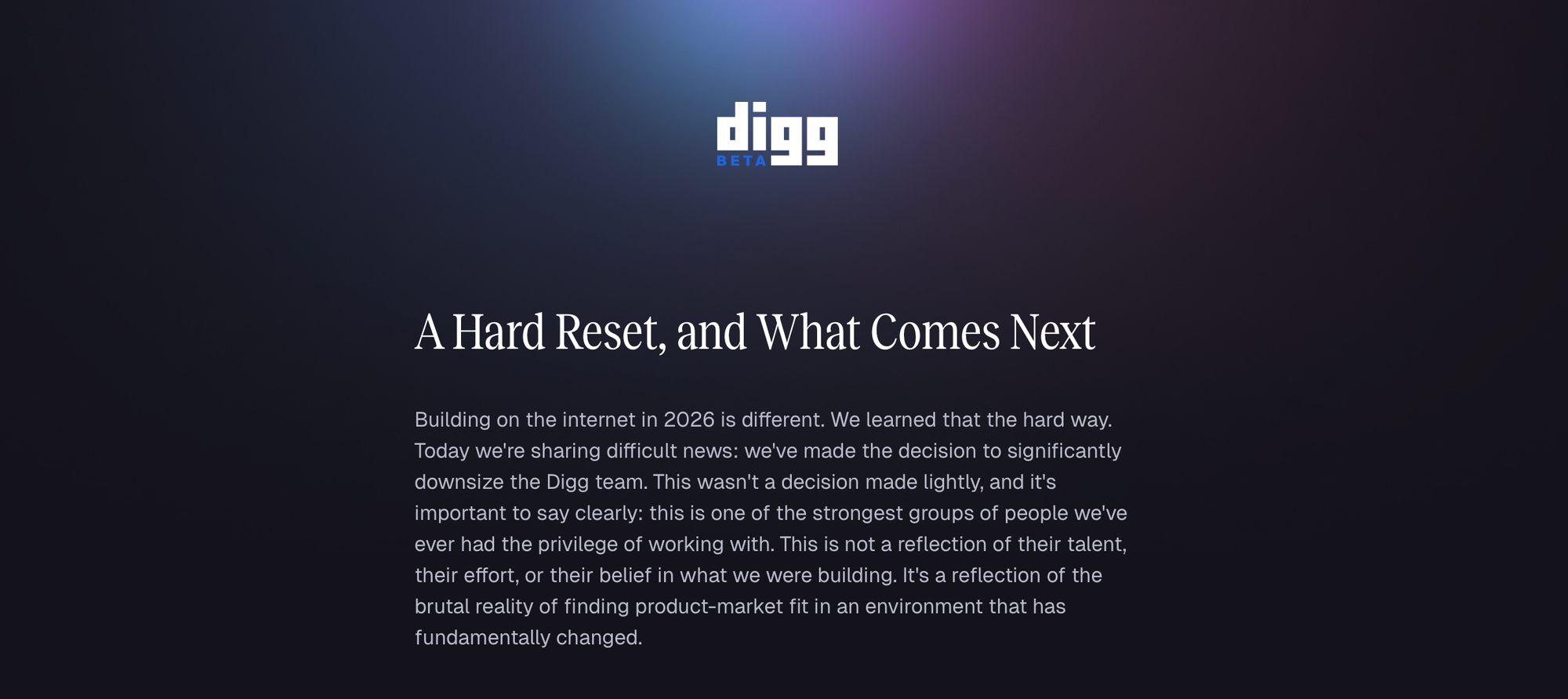
Unprecedented, maybe - but unexpected?
I’m not so sure.
Digg’s strong domain reputation acted as a magnet, and the site was rapidly overwhelmed by automated spam and fake accounts looking to take advantage of the SEO opportunities; but I think it was the absence of modern moderation infrastructure that was squarely to blame for their downfall this time around, not the bots themselves.
Digg launched a ranking-based community product before they had strong enough systems to keep identity, engagement, and moderation signals trustworthy under attack; they were moderating content when the real problem was adversarial trust at the system level.
Digg was a platform many of us loved, and we were excited to see its return - so I think it’s easy to blame its second downfall on an Internet Gone Bad.
But that implies it was inevitable, and it will be inevitable for other social and community platforms.
At Discourse, we don’t believe that’s the case.
Welcome to the Dead Internet
I’ll be the first to admit that the Dead Internet Theory is no longer theoretical. AI tools have made bot creation trivially easy and automated spam cheaper, faster, and more sophisticated. We’re in a rapidly scaling reality where humans are getting drowned out by bots that write (almost) like us.
And therein lies the crux of Digg’s latest collapse: an authenticity crisis that happened because no one could distinguish between the humans and the puppets.
“This isn’t just a Digg problem. It’s an internet problem. But it hit us harder because trust is the product. When you can’t trust that the votes, the comments, and the engagement you’re seeing are real, you’ve lost the foundation a community platform is built on.”
The simple fact that no one could trust that votes were authentic undermined the foundation of the community. For a platform that was relaunched on the promise of a more trustworthy social experience for the AI era, the inability to establish that the activity on the platform was actually human was...a little ironic.
What Digg Got Wrong
Digg’s creators underestimated the spam landscape (spamscape?) and launched with tooling designed to protect against the threats of the last decade instead of the current. Mezzell described Digg’s development strategy as ‘building the plane as we fly it.’ This is the evergreen tension between fast-paced feature development and the necessary - but often, slower - work of building secure, trustworthy foundational infrastructure.
Practically speaking, the platform lacked any form of proactive detection, relying on reactive human moderation instead that simply does not (and cannot) scale. Missing authentication layers and the absence of anti-sybil mechanisms made it easy to create fake accounts. But rather than implementing AI countermeasures, Digg tried to contain the flood of automated bots through manual review. Insufficient rate limiting compounded the problem by enabling mass automated posting.
“We knew bots were part of the landscape, but we didn’t appreciate the scale, sophistication, or speed at which they’d find us. We banned tens of thousands of accounts. We deployed internal tooling and industry-standard external vendors. None of it was enough.”
During the beta stage, users were limited to a small set of internally managed communities; then at public launch, Digg immediately decentralised moderation before it had the safeguards in place to support it.
User-created communities opened up, and community managers set their own rules with public logs. They effectively accelerated the fragmentation of their community under the fatal assumption that self-moderation would be enough. But there were no experienced moderators, no established rules or norms, and no documented moderation framework - and the platform was wide open to abuse.
The Bot Evolution Problem
It took most of the 2010s for bots to evolve from crude scripts that automated basic actions into somewhat more human-seeming “social spambots”. But the decade we’re in now is already at the mercy of generative AI, and the speed of change has made the sophistication gap enormous.
Advances in language quality, behavioural realism, speed, and scale have made evasive and coordinated attacks far more effective. This was the environment that Digg relaunched into. The thousands of accounts created per hour made it extraordinarily hard to contain; and adaptive bots compounded the problem by learning moderation patterns and responding in real time.
It’s nothing short of an arms race, with platforms fighting to stay human in the face of increasingly sophisticated automation.
Why Open Platforms Are Especially Vulnerable
Openness is both a feature and a liability. Frictionless account creation lowers the barrier to entry for humans, but it also leaves platforms vulnerable to abuse. Without some reliable way to distinguish between humans and agentic systems, the underlying mechanics begin to break down. Democratic voting systems are perfect targets for manipulation, free content creation removes any cost barrier to spam, and viral mechanics are especially vulnerable to coordinated bot networks capable of gaming engagement algorithms.
A bot network doesn't need to fool everyone; it only needs to distort the first impression.
Established players like Reddit survive because of their entrenched network effects: bots are absorbed into the noise or diluted by scale. But for new communities, the dilemma is much sharper. How do you preserve the benefits of openness without sacrificing trust in the system itself?
Discourse's Approach: Layered Defense
Digg’s plan to pick up “little signals of trust along the way and bundle them all together into something that’s meaningful” was compelling in the abstract, but the modern internet is unforgiving.
Discourse didn’t launch into a vacuum; we understood the risks and built layered defenses into the product from the beginning. We start by applying strategic friction at the door by requiring verified email authentication for new accounts. From there, AI spam detection identifies suspicious behavioural patterns, like completing a rich profile without reading any posts. It’s proactive, behaviour based detection and it does a lot of the heavy lifting, but there's always a human in the loop: AI flags, humans decide.
Our most powerful layer of defence is the Trust Level System, baked into the product from inception. It’s a framework of earned privileges: new users are sandboxed while they build trust within the community, removing the possibility of instant credibility and creates enormous friction for abuse, because bots can’t easily build long term reputation.
Additional layers, including rate limiting to prevent mass automated actions and a robust community reporting framework, create an environment in which authenticity is much harder to fake.
AI Spam Detection in Practice
The silver lining is that the same technology making abuse more sophisticated is making detection scalable - if it's done right. AI pattern recognition works by spotting signals that look statistically unusual, even when individual actions seem normal, like the profile example from earlier. AI content analysis ingests huge volumes of content and scans for characteristics associated with AI-generated text, flagging them for additional human review.
Network analysis broadens detection beyond individual accounts by looking at how they behave in relation to each other, making it possible to detect coordinated bot rings. Velocity monitoring helps catch unusual posting patterns, like up-voting at machine speed or coordinated sock-puppet campaigns designed to build reputation. Add to that the ability of these systems to continuously learn and adapt to new tactics, and it starts to look like a pretty powerful first line of defense.
Just what Digg needed.
Why Human Review Still Matters
AI can catch patterns at scale, but context still matters. We need human judgment to interpret intent, nuance, and the difference between actual abusive behaviour and that which is just unusual. AI might flag awkward phrasing from a non-native speaker, so having a human-in-the-loop is important to prevent false positives; and humans have the added advantage of understanding community-specific context - they know the norms, the tone, the boundaries, and the usual patterns of engagement.
More importantly, humans are capable of transparency and accountability. Having someone responsible for moderation decisions who can explain why those decisions were made is vital for building trust.
What everyone needs, what every platform needs is balance: automation for scale, humans for judgment.
What Other Platforms Get Wrong
In the absence of that balance, things can go wrong, and they can go wrong fast. Without human oversight, AI makes mistakes that compound and erode trust. But Digg also showed us the opposite problem: that pure human moderation doesn’t scale to modern threat levels.
A common mistake is failing to verify personhood in any meaningful way at sign-up, treating all users as equally trustworthy. If new accounts are automatically granted full privileges, they gain instant access to multiple attack vectors.
Manual moderation misses patterns because it treats each spam post in isolation. In an unsecured environment that relies on reactive moderation, the blast radius is so large that much of the real and reputational damage has already been done by the time a human gets in the loop.
The Cost of Getting It Wrong
Once that initial impression is distorted, a user exodus will follow. It starts with a drop in sign-ups, then compounds as the platform gains a reputation as a spam haven and the downstream effects gather momentum. Advertisers start pulling their spending because they no longer trust the environment and don’t want to risk reputational damage from being associated with it. SEO penalties accumulate as search engines begin to downrank the site, weakening discovery by real humans, and the death spiral accelerates.
The warning is clear: Digg's fate is likely waiting for any platforms that fail to invest in trust infrastructure.
Building Sustainable Moderation
Sustainable moderation starts with infrastructure: platforms need tooling that can turn “moderation” into an enforceable system, and early investment makes all the difference. These capabilities must be baked into the platform’s design, partly because they're hard to retrofit, but primarily because you will actually need them from day one - as Digg demonstrated.
Moderation alone comes too late to stop wide-scale bot attacks; the real work is done earlier by the systems designed to prevent abuse from getting through the front door in the first place. The key is layered defense, with multiple systems working together. Identity verification, accumulated trust frameworks, and AI triaging should all come before the content moderation stage. Once content does reach that point, moderators need to be equipped with appropriate tools and the authority to act quickly.
Scalable moderation depends on community partnership - on turning members into an active part of the defense system. Crowdsourcing moderation through some form of flagging system means that it scales with the community, and it reinforces cultural norms and values at the same time.
The final - and, I'd argue, the most important - layer is ongoing adaptation. Bot tactics evolve, and our defenses have to evolve to meet them. We still believe that staying open source is a better answer to any AI-powered bad actors, and the spam / bot battle is no different.
Lessons for Community Builders
We are now living in a world where online authenticity has become a technical prerequisite. Bootstrapping community is getting harder every day, because the authenticity problem is now part of the cold start problem, unless you already have that friction at the door. For community builders, that means treating trust as table stakes. The challenge used to be getting people to show up; now it's making sure only the actual people are allowed in when they arrive.
To do that, communities have to invest in and build defenses before they actually need them. Moderation infrastructure is no longer optional; ignore the bot threat while you’re building the plane in flight, and you may never get the chance to land.
I’m sad to see Digg shut down a second time.
And I have nothing but respect for their founders.
Their platform represented so much of what I fell in love with about the internet, and I think they had an idealistic view of the open web that I do believe in.
Sadly - I think the internet of 2026 needs a degree of realism tempering that idealism.
Comments