What It's Actually Like to Use Discourse in Another Language
The real-world experience of the AI translation feature we shipped in 2025


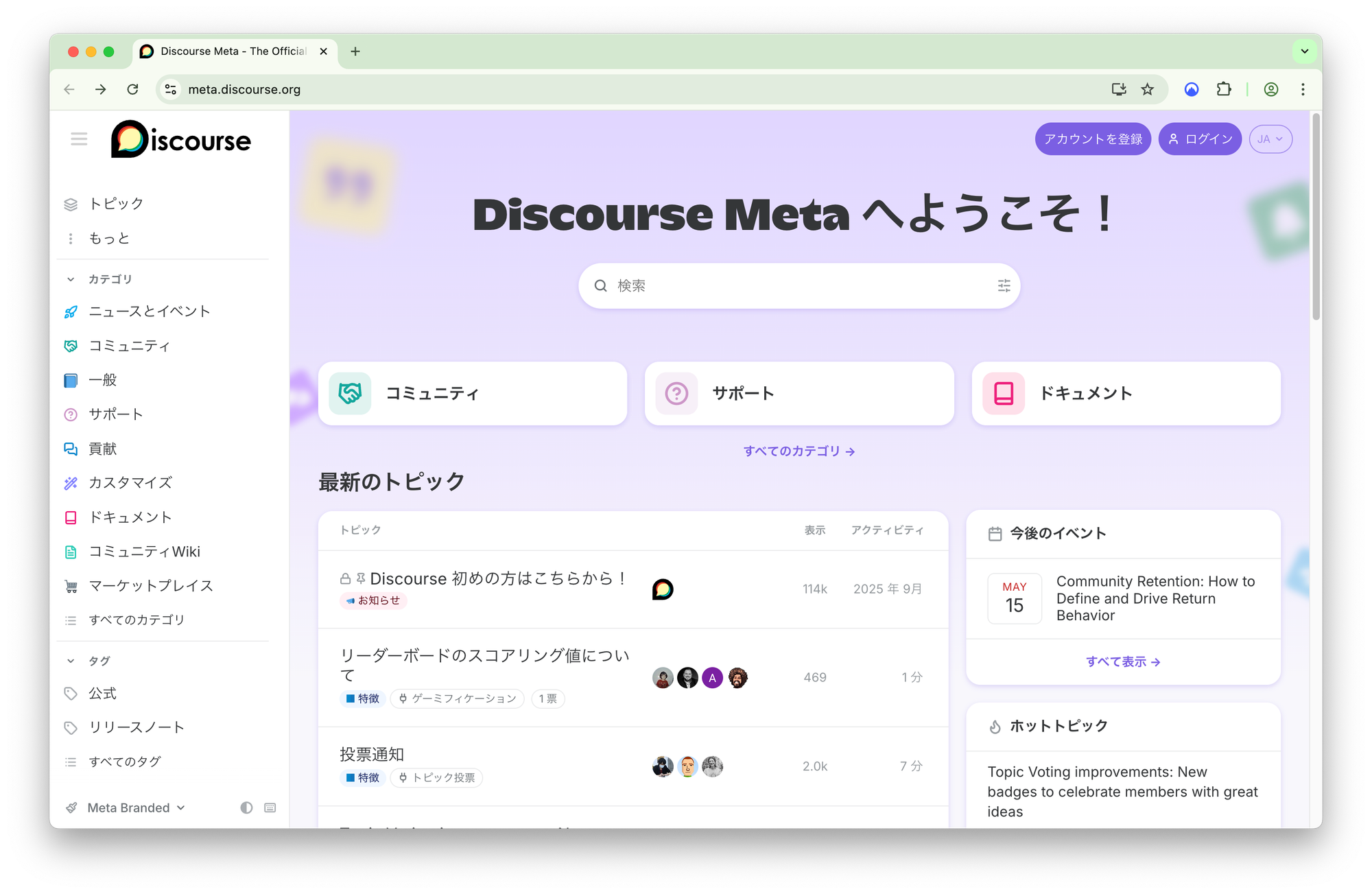
This is what it looks like when you open https://meta.discourse.org (our public community for Discourse) in a browser set to Japanese.
The welcome banner reads "Discourse Meta へようこそ!" and the sidebar lists トピック, コミュニティ, サポート, カスタマイズ, ドキュメント where you'd normally see Topics, Community, Support, Customization, Documentation. The topic list is in Japanese too: "Discourse 初めの方はこちらから!" is "New to Discourse? Start here!", "リーダーボードのスコアリング値について" is a support question about leaderboard scoring, and "投票通知" is a feature topic about vote notifications.
The whole page reads as though it was built for a Japanese-speaking audience, from the navigation to the search placeholder (検索) to the tag labels (公式, リリースノート). Switch the dropdown to Portuguese and the same forum becomes "Boas-vindas ao Discourse Meta!" with Comunidade, Suporte, Documentação in the sidebar, and topics such as "Como forçar um tópico a ser editado pelo usuário" (a support question about forcing topic edits) and "Middleware: profundidade da árvore de documentos excedida" (a bug report about document tree depth).
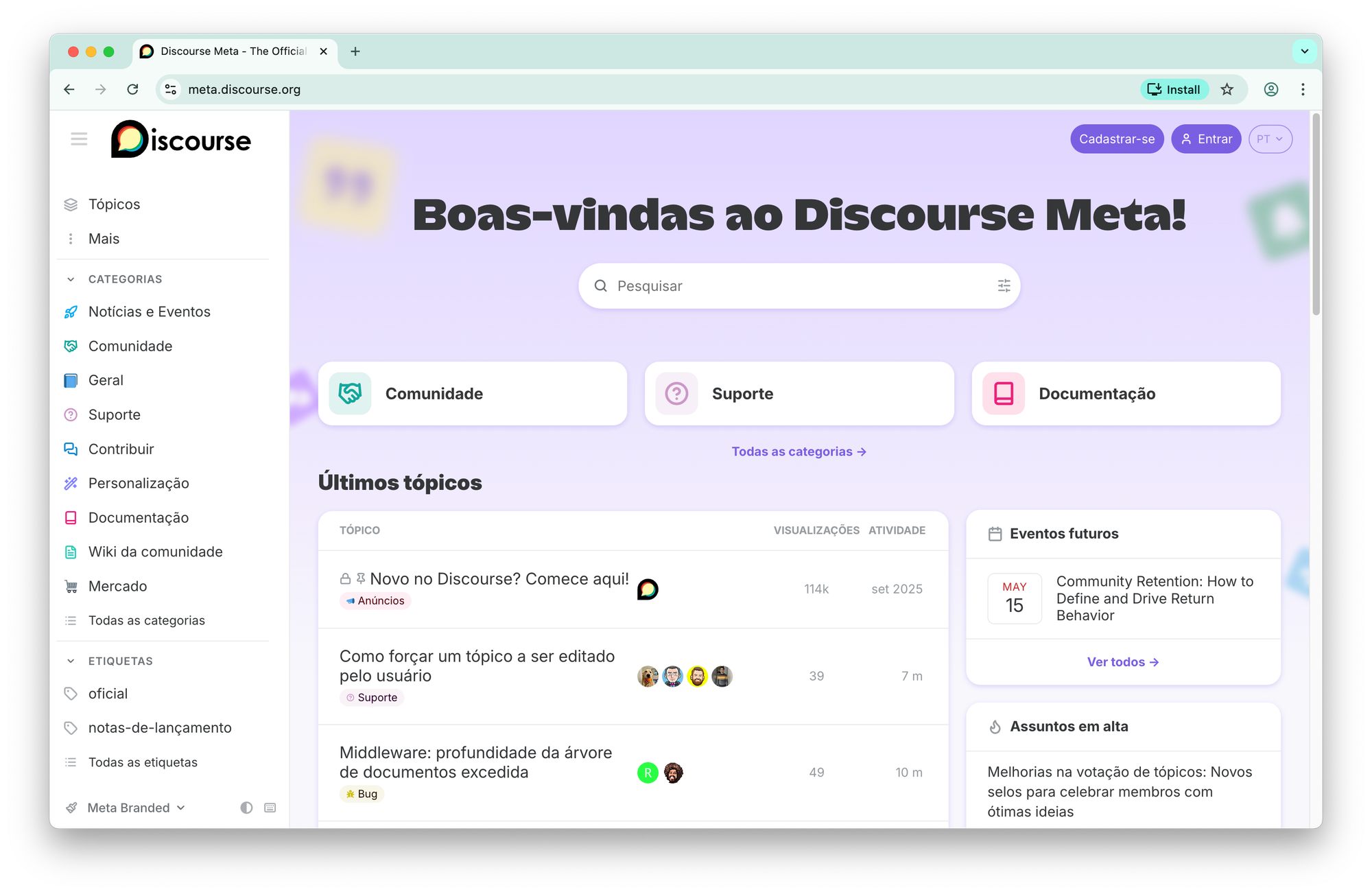
This is the real-world experience of the AI translation feature we shipped in 2025. One dropdown in the top right corner transforms the entire forum: topic titles, post bodies, even category and tag names.
Click into a topic and see the other direction. This support post was written in German by someone who opens with "My English isn't the best, so I'm writing the text in German." An English reader sees clean, natural English, including that sentence. The only hint is a small language icon next to the post date.
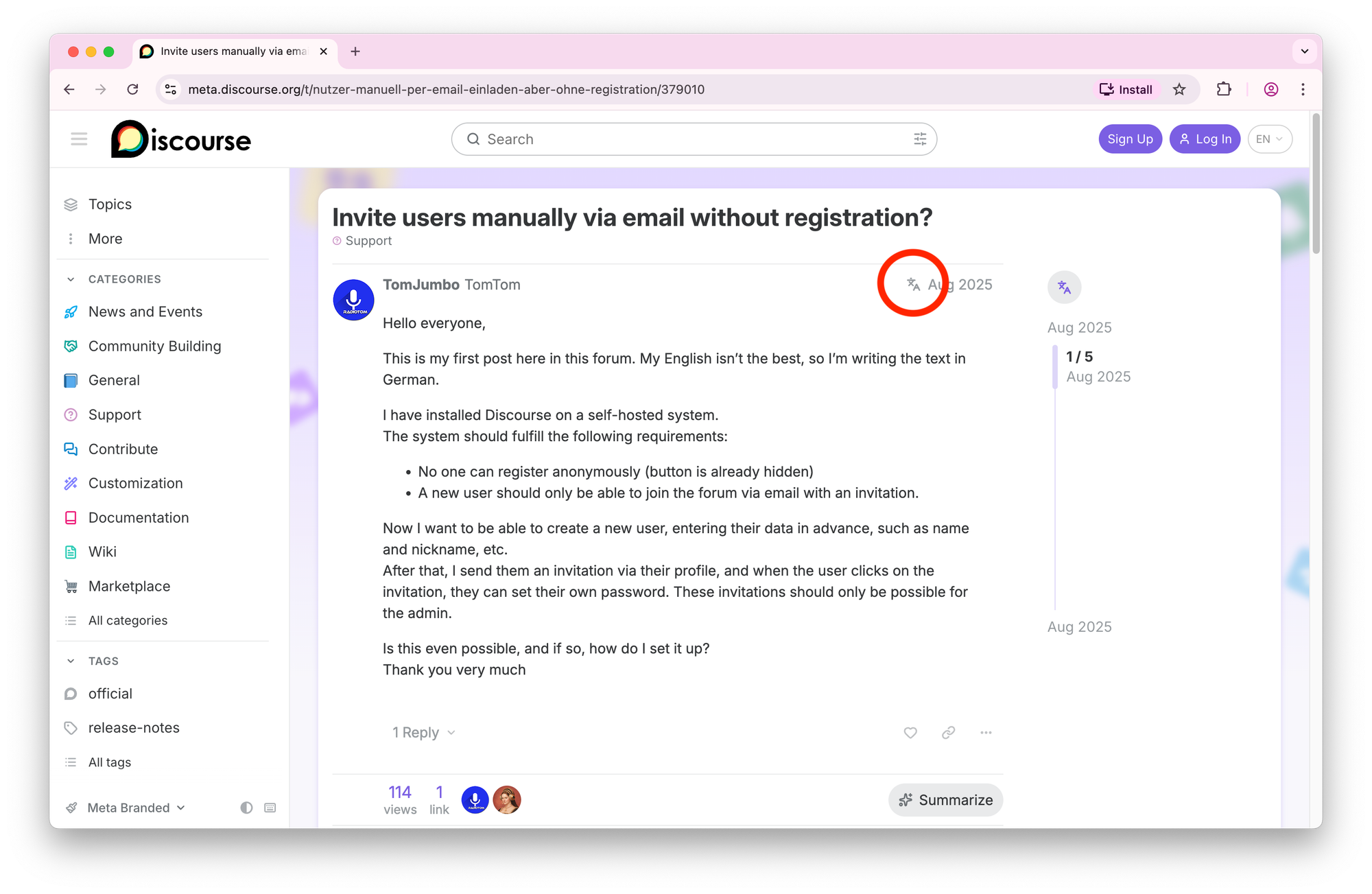
That's pretty much the experience from both sides. A Japanese reader browses meta and everything reads Japanese; An English reader clicks into a German post and it reads English. There's no banner saying "This post was automatically translated," no purple notice, no asterisk. You could browse for quite a while before realizing the words you're reading were written in a different language!
If you read my previous blog post, you'll see that this is the "magical babel fish mode where you select your language and we just auto translate everything." realised.
Who's actually here on meta?
In our first post in the series, I mentioned that 36% of visitors to https://meta.discourse.org have a non-English browser language.
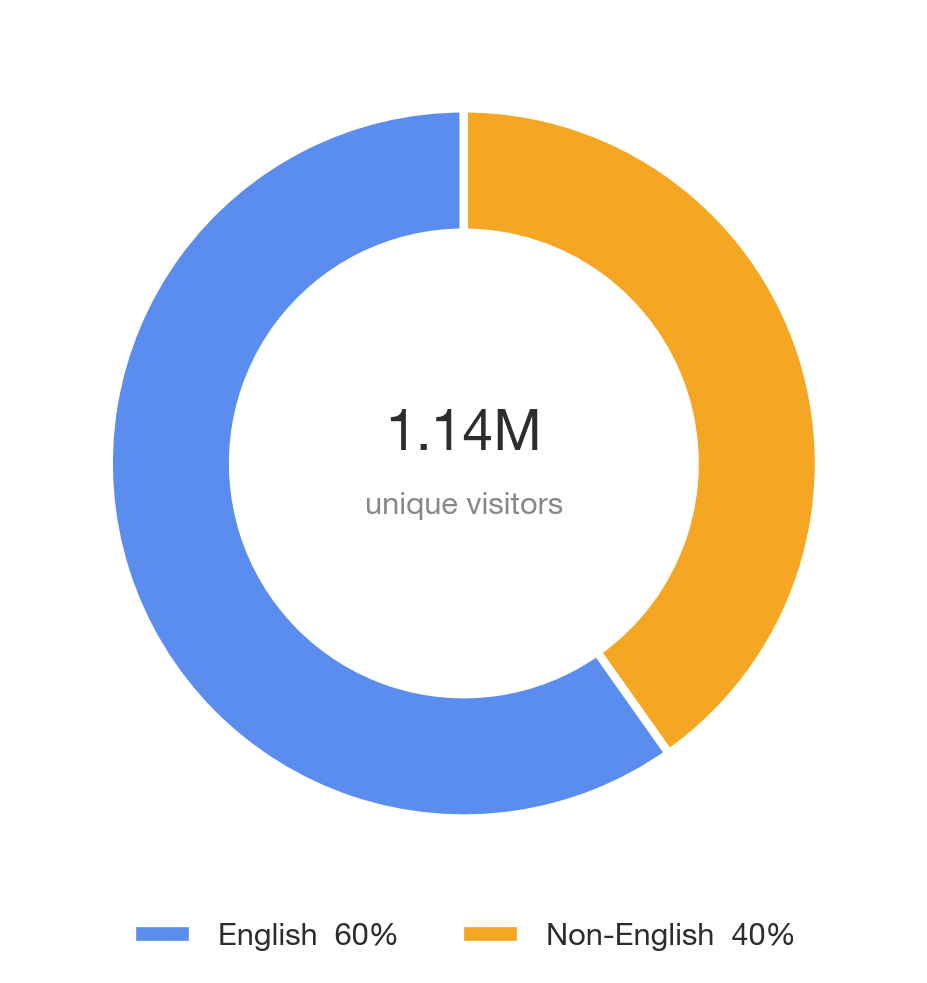
A fresh 30-day pull puts it at 40%. Over 1.14 million unique IPs visited meta in that window, 682,000 with English browsers (59.8%) and 459,000 with something else, across 96 distinct languages. The second language isn't German or Spanish or French. It's Chinese, at 408,000, nearly 60% of the English number and 50 times larger than German in third place at 8,200.
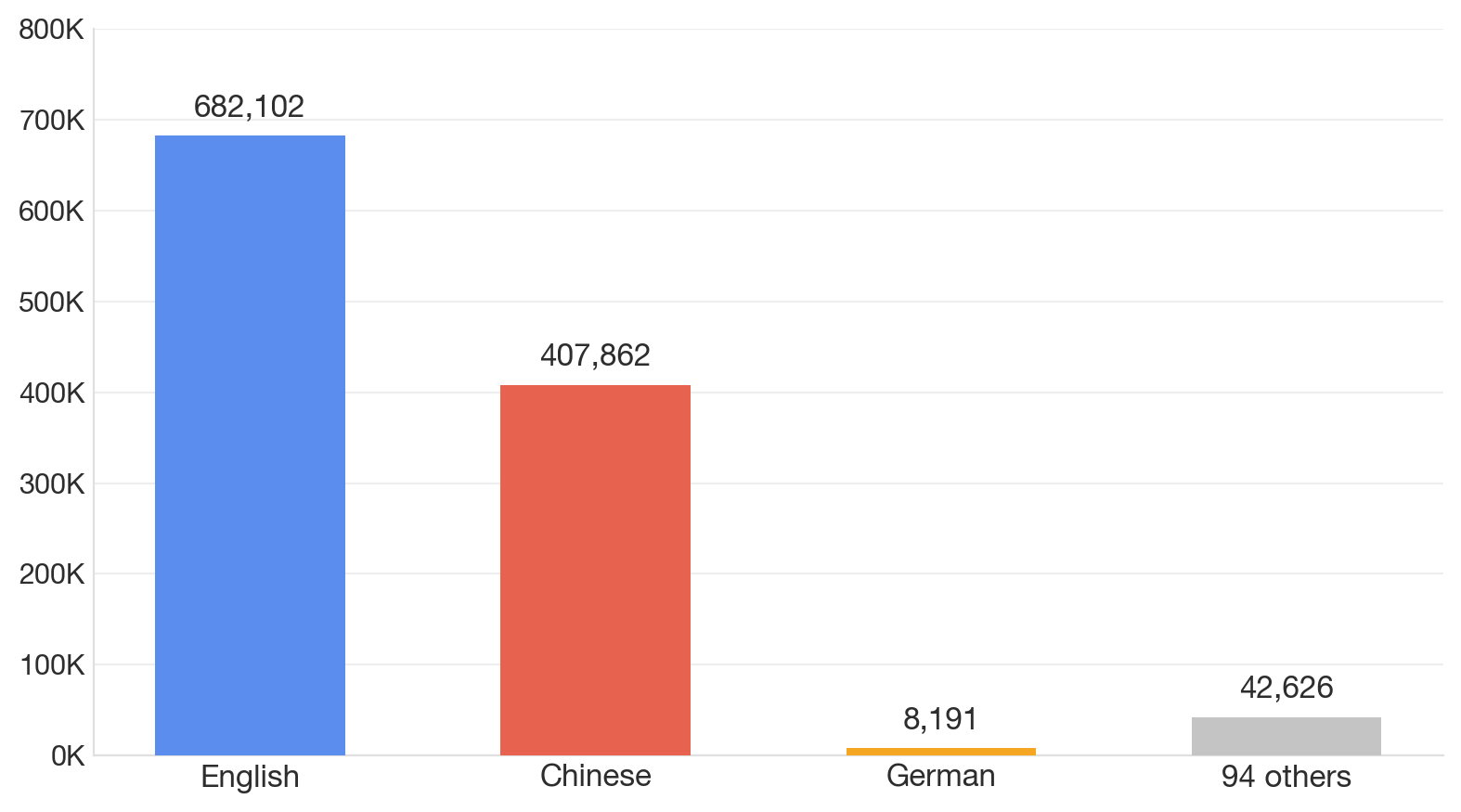
There are a few caveats to this data, however. Accept-Language is a browser setting and not a fluency test, so it tells us what language someone's browser is configured in rather than what they speak at home. What's more, the Chinese number almost certainly includes crawlers and bots that we haven't fully separated out, and I'd rather be honest about that than present it as clean. But even if we remove Chinese entirely, we'd still have 51,000 unique visitors in a single month browsing meta with a non-English browser - a community within the community that existed long before we built our translation feature.
Non-English participation on meta
Visitors are one thing, but participation is another!
We tracked non-English public posts on meta (we have private ones too) from January 2023 through to April 2026. In early 2023 the numbers were in single digits, maybe two or five or fifteen posts in a given month. By late 2025 the count was consistently between 70 and 90 per month, and in early 2026 it jumped again, hitting 169 in April.
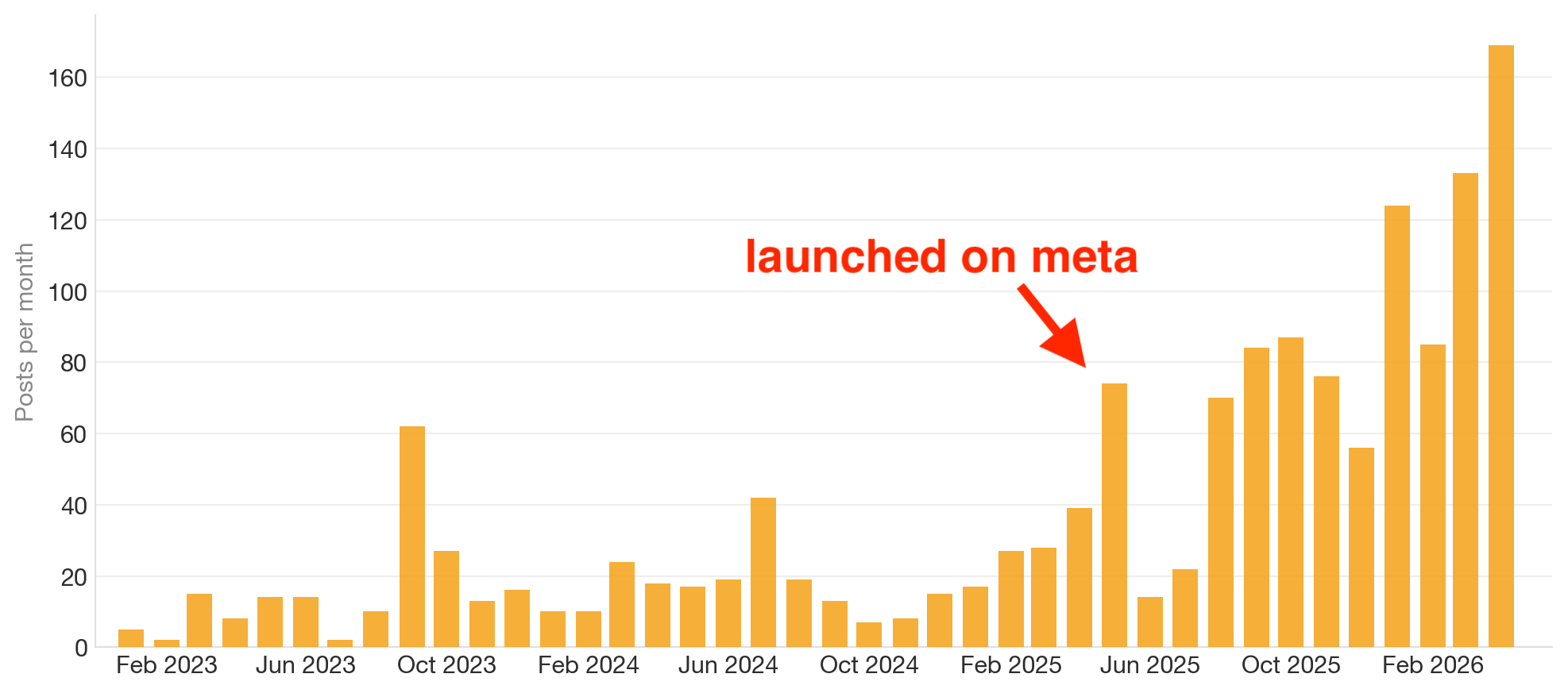
The upward trend entirely coincides with our AI translations feature going live. I feel comfortable saying that people write more when they can read the conversation around them. I don't want to oversell this, but 169 non-English public posts in a month on a forum with meta's volume is still a small fraction of the total, and the question that matters more than the count is whether those posts actually get responses or land in a void.
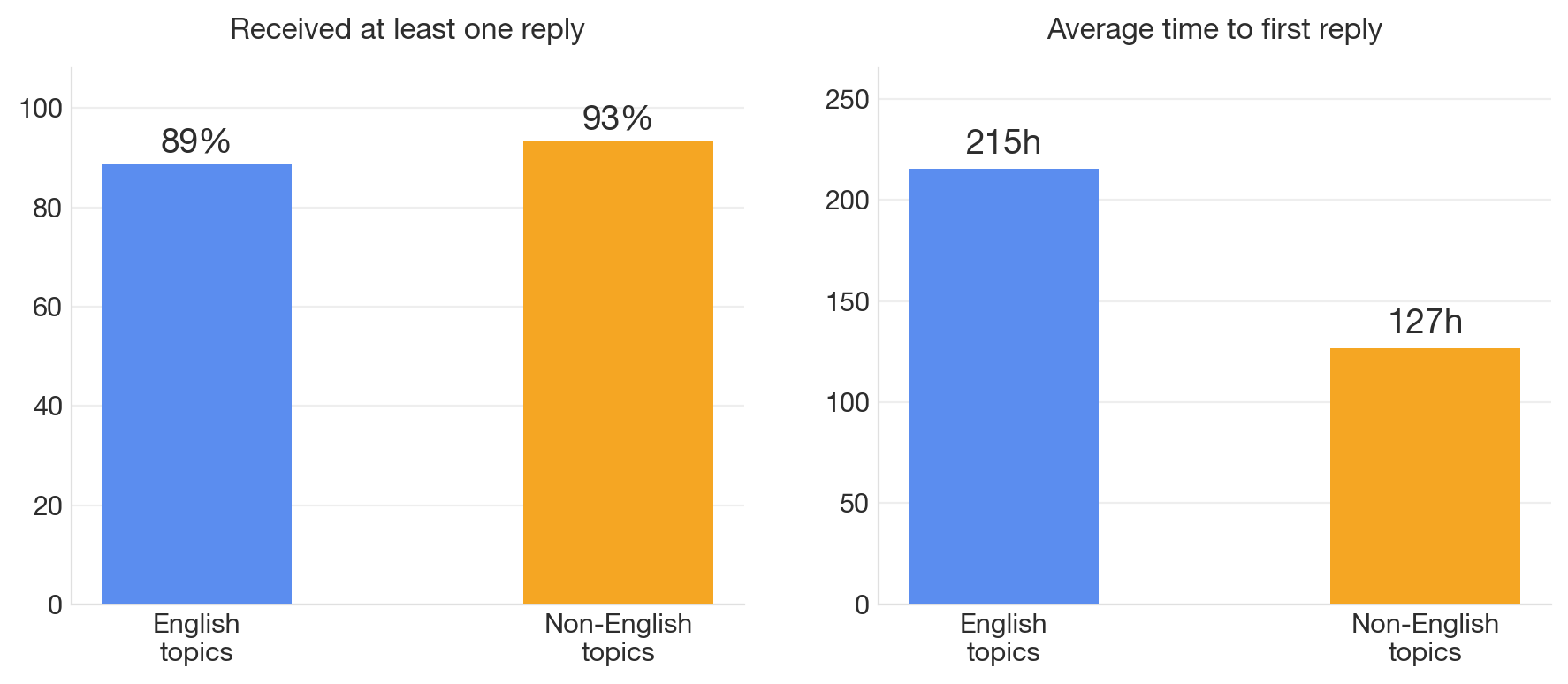
Since January 2023, 371 non-English topics have been created on meta and 93% of them received at least one reply, slightly higher than the 89% reply rate for English topics. Non-English topics also got their first reply faster on average. So, as a reader, if you want to get a response on meta, you could try writing in a language other than English! 😼
Chinese is the most-written non-English language on meta at 759 posts, then French and German nearly tied around 240 each, then Spanish (75) and Portuguese (62). After that it drops to double and single digits across Italian, Russian, Finnish, Japanese, Turkish, and about a dozen more.
So what's driving all this traffic?
…And how are 459,000 non-English visitors in a single month finding meta?
Most of them aren't existing community members browsing in another language; they're arriving from Google, and they're arriving because since August 2025, Discourse serves translated content directly to search engine crawlers.
When Google crawls a topic on a site with Content Localization enabled, it picks up hreflang tags pointing to a translated URL variant for each supported language, and indexes each one as a separate page. So a topic written in English about configuring SSO can rank in French, Spanish, or Japanese search results, with the title, excerpt, and content all in that language.
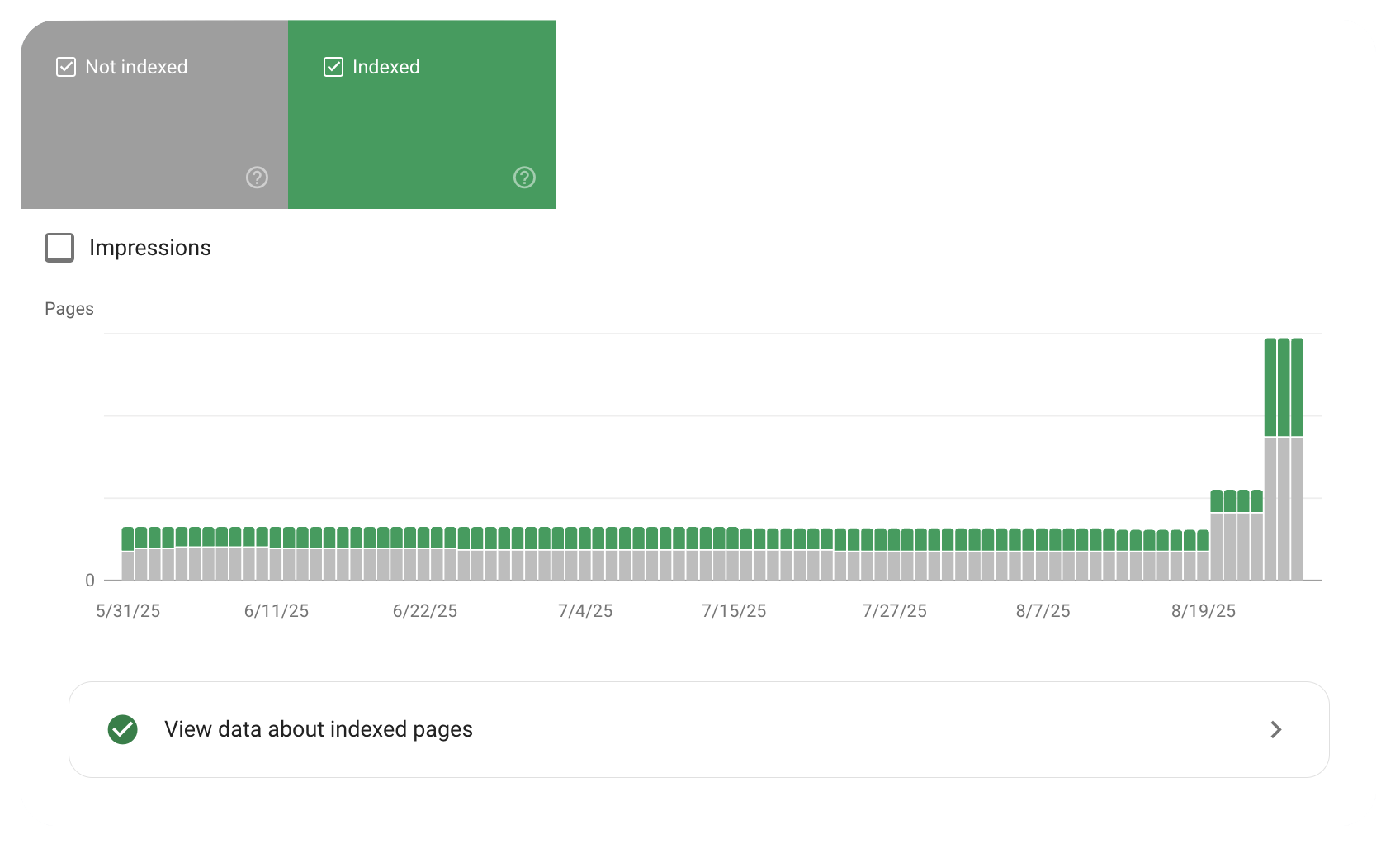
This is meta's Google Search Console after we introduced translated crawler pages (note the green area). Each supported language gets its own set of indexed URLs, so meta's content is now discoverable in 10 languages instead of one.
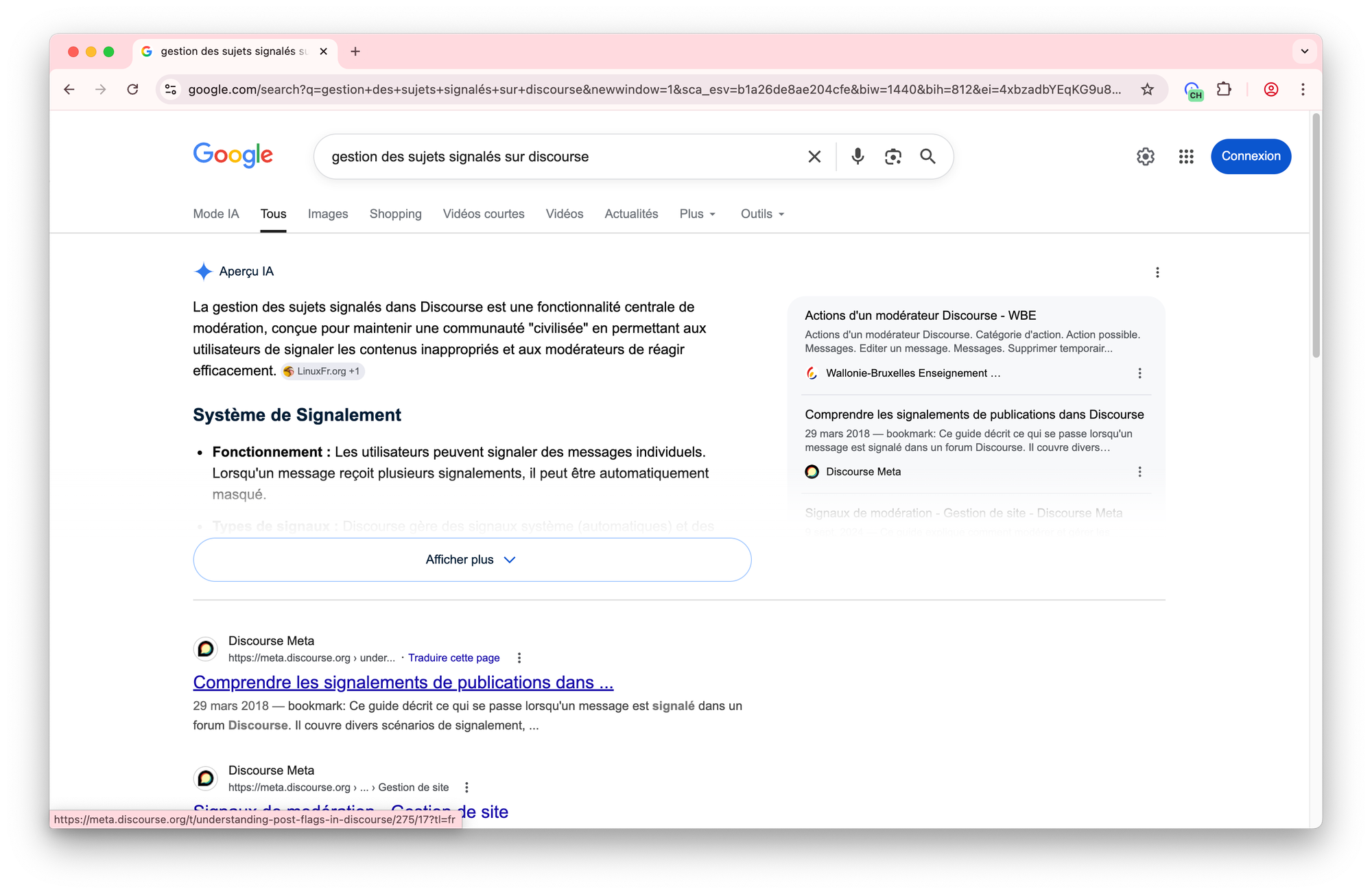
A French-language Google search for Discourse topics returns meta results with French titles and French excerpts, indistinguishable from content originally written in French. One of our customers, running a French-language forum, enabled the same crawler setting and within two weeks had their topics appearing in Spanish Google results.
Reddit did this first and reported in late 2024 that machine translation drove a 4x increase in daily active users, largely because translated pages ranked alongside originals and effectively doubled their search presence. We follow the same ?tl= URL pattern, adapted for the thousands of communities running Discourse rather than one centralized site.
Multilingual SEO has a lot of moving parts (hreflang tags, self-referencing canonicals, sitemap entries) and we're actively refining how these work together. The feature is available on all plans, so any Discourse site with Content Localization can start showing up in search results in every language it supports.
When translation works
Asa is a Portuguese speaker and an avid community member on meta:
"My English is very poor, and I am grateful for the function that translates it into my language. So far, I have been able to understand everything here."
Someone who couldn't meaningfully participate in meta's English-language discussions can now follow along, ask questions, and get answers, not as a hypothetical but right now on the forum. TroLLoBloger, who runs a forum from Bulgaria with automatic translation into four languages, put it this way:
"If you use AI as a tool, and not as a replacement for humans, then I don't see what problem there could be."
And Jagster, who's Finnish and has spent years reading and writing English as a second language on international forums, offered a useful perspective on the baseline; translation doesn't need to be perfect, it needs to be better than the alternative, and the alternative is often either struggling through English or staying silent.
"Everyone here, and at every global forum, has used to read broken English."
For the bread-and-butter content of a support forum (bug reports, support, feature requests with clear steps) translation works well. Someone asks how to configure SSO in Portuguese, the English-speaking team reads the translated version and replies, the reply gets translated back, and the problem gets solved. ✅
When it breaks
The failures tend to show up where language carries more than information. The nuances and quirks of linguistics are real features of how different languages work, and better algorithms alone won't fix the missing context.
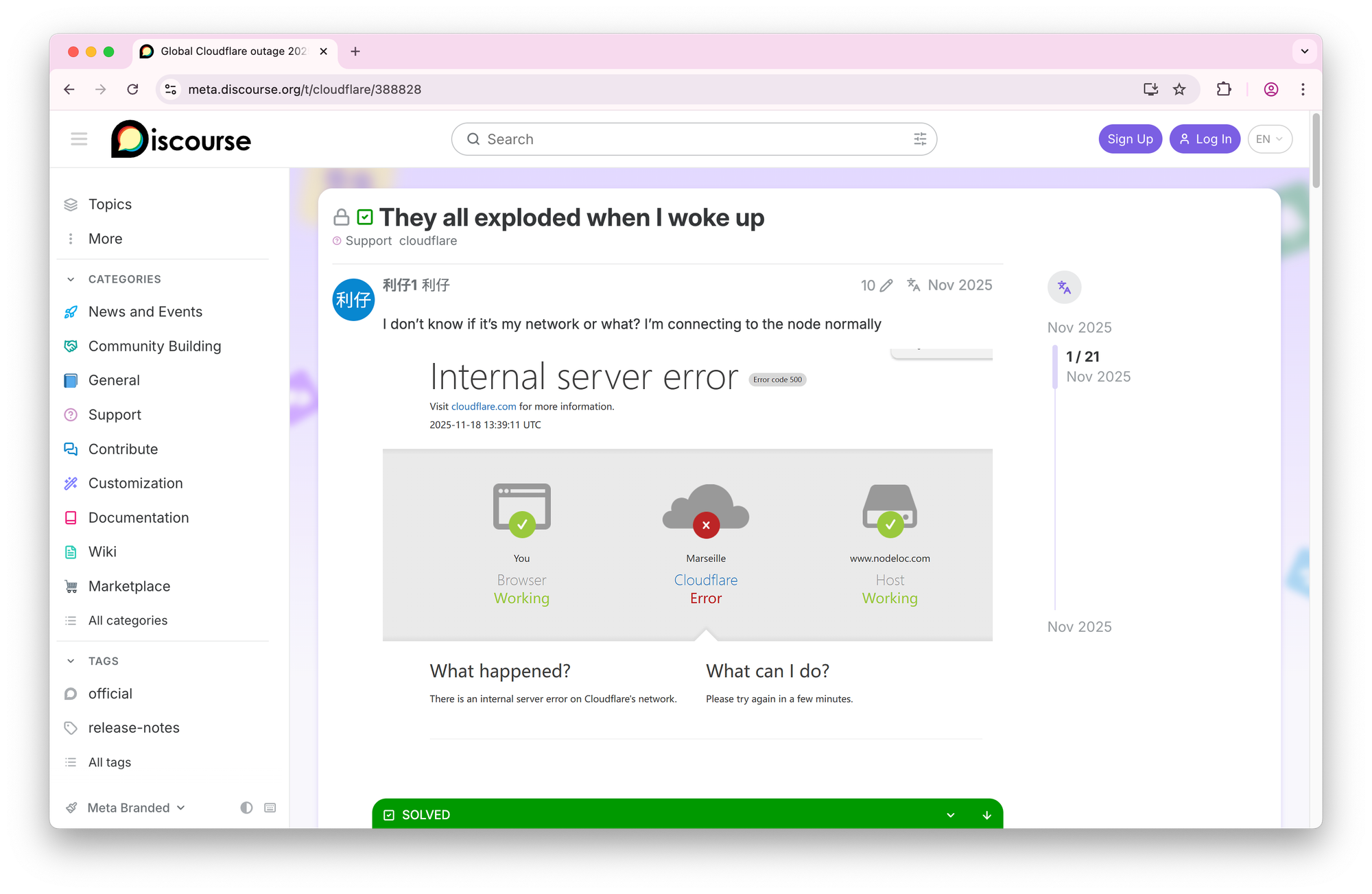
Sometimes the translation can go off the rails entirely. A community member posted a topic in Chinese about a global Cloudflare outage “一觉睡醒他们都炸了”, and the AI-translated English title came out as "They all exploded when I woke up." Multiple people tried to fix it and kept hitting translation errors, so it stayed that way for a while. That one was funny and our team (read: me) had a good laugh - but it points at a real problem: when a title is wrong, it's the first thing everyone sees and the last thing that gets corrected.
There's also the opposite problem: translation you don't want. In the Nordics and much of Europe, speaking three or four languages is normal, and the current model doesn't account for that well. A French-English bilingual user, Stephtara, described what she actually wants:
"Ideally, as a user, I'd like to be able to say 'never translate French or English; for German and Italian and Spanish, give me the translate link; for other languages please translate directly and give me a link to revert to the original'"
Right now Discourse gives you a single language toggle and everything gets translated into it. Real multilingualism isn't a toggle, it's a spectrum. We have a feature request for multi-language preferences, the ability to say "I speak these four languages, only translate the rest."
The Human gap
Meta's language switcher offers 10 languages: Arabic, Chinese, English, French, German, Italian, Japanese, Portuguese, Russian, and Spanish. Visitors come in 96 languages as expressed above in our site statistics. Turkish has 4,300 visitors a month and 13 posts on meta, but a Turkish speaker can't use the language switcher.
For the 10 languages we do translate into, every translation is AI-generated with only an occasional human review step. We rely on the community to catch what the AI gets wrong, and honestly, that's how Discourse has always worked. Our interface translations on Crowdin have been community-contributed for over a decade. Members like Moin, asa, and RGJ help shape how Meta works for everyone, including flagging translations that miss the mark. The difference now is scale: when every post gets translated into 10 languages automatically, there's a lot more surface area for things to go wrong, and we need more people across more languages paying attention.
We've added a custom flag type on meta for exactly this: "Inaccurate Translation." If you're reading a post in your language and the translation is wrong, you can flag it and tell us which language you're viewing it in so staff can delete or fix the translation. It's a small thing, but it turns every multilingual reader into a potential reviewer.
What this adds up to…
A core part of our mission at Discourse is to connect people - we believe in the power of human connection and human conversation to make the internet, and the world in which it exists, a better place. We’ve always recognised that connection has to happen across barriers, borders and languages, and our Multilingual work is the result. We’re putting more time and thought into this than ever before, and we welcome feedback, ideas and notes - this is a community effort, for a community-led feature.
I’m incredibly proud that we’ve been able to go from "post in English or miss out" to "post in your language and get a reply within hours" - it’s a very real benefit for our users and our people, and the data backs it up. The next year is about closing the gaps - more languages in the switcher, smarter preferences for multilingual readers, and better tools for the community members who work and collaborate to make our translations better. If you've spotted something off in a translation, please flag it, and if your language isn't on the list yet, tell us. This works because people show up, and we thank you for it.
Comments